Reliable Social Media Service Providers
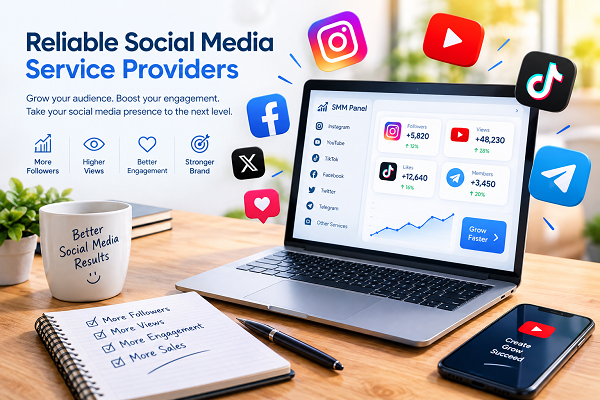
Running social media accounts is a grind. You manage a business profile, push a brand, keep several client accounts alive, and somehow you're expected to build an audience on every network at once. That's why people start looking at social media marketing services in the first place.
Here's my take. A good provider offers more
than a pretty price list. Clear descriptions, an ordering process you can
follow without guessing, and support that actually answers. Some users need
cheap packages for one account. Others want a global SMM panel that covers
several networks from one place. Both exist.
Which one you pick depends on your goal and
your budget. Compare before you order. And know what a service can
realistically deliver before you pay.
Best SMM Panel Companies
The best panel isn't automatically the one
with the biggest catalog or the lowest price. I'd look for a provider that
makes it easy to see what's on offer, compare packages, and manage orders
without headaches.
For businesses and marketers, convenience
matters. Instead of juggling five different sellers, one panel can cover
Instagram, YouTube, TikTok, Facebook, and Telegram from a single dashboard.
That alone makes daily campaign work less chaotic.
What I'd actually check:
·
Service variety: Does the panel
cover the networks you work with?
·
Transparent pricing: Are prices
and package details readable?
·
Order tracking: Can you see
your order history without digging?
·
Customer support: Is help
reachable when an order goes sideways?
·
Clear policies: Are refund and
cancellation terms visible before payment?
A huge catalog looks impressive. You won't
use half of it. Start with the networks that match your goal, then compare on
those.
Cheap SMM Panel Sites
Affordable panels appeal to anyone watching
their marketing budget closely. Small businesses, solo creators, agencies,
people testing ideas. All of them. Low prices make it easy to try a service or
start with a small order. But price alone is a bad compass. A cheap service
with murky terms is worth less than a fair-priced one that tells you exactly
what it does.
Before picking a low-cost panel, compare
these:
·
Price per package: Match
equivalent quantities, not headline numbers.
·
Service descriptions: Know
what's included and what isn't.
·
Minimum orders: Check whether
the smallest package even fits your budget.
·
Support: Find out how to reach
someone if help is needed.
·
Payment terms: Look at payment
methods and any extra fees.
One more thing. Cheap marketing tool is not
the same as guaranteed business results. A low-cost service can't magically
produce sales or long-term audience growth.
A small first order is a sane way to test
the process. Once you've seen how the service works and where it stops, you
know whether it deserves more of your budget.
Is Social Media Marketing Expensive?
Not necessarily. It depends on what you're
trying to achieve. Making content yourself, using scheduling tools, hiring an
agency, running ads, buying third-party services. Every path costs something
different.
For a small business, starting with a tight
budget and a couple of key channels beats trying to be everywhere. An
established company needs more: reporting, content production, campaign
management.
Here's a quick reality check:
|
Approach |
Main cost consideration |
|
Organic
content |
Time,
planning, and content production |
|
Paid
advertising |
Campaign
budget and audience targeting |
|
SMM
panels |
Package
prices and service conditions |
|
Agency
services |
Professional
fees and campaign scope |
|
Social
media tools |
Monthly
or annual subscriptions |
Start with the goal. Attracting visitors?
Pushing a product? Building awareness? Building a community? Once you know, the
spending decision gets clearer. Cheap tools handle specific tasks. They work
best as support for a wider plan, not as a replacement for one.
Global SMM Panel Companies
Global panels serve people who manage
accounts and campaigns across countries and networks. Agencies and
international businesses often use one provider for everything so purchasing
and orders stay in one place. The draw is convenience. One dashboard to compare
services, organize orders, run several projects. Useful when a business handles
different audiences or multiple client accounts.
But "global" doesn't mean every
service fits every market. Delivery terms, supported networks, payment methods,
and support can all vary. When checking a global provider, look at whether the
descriptions are clear and whether the options match the countries and networks
you actually work with. Also check how they handle questions and disputes.
If you run several projects, ease of use
matters as much as price. A provider that keeps order management simple saves
you admin time, as long as the services meet your needs and respect the network
rules.
Which SMM Panel Companies Are Most Reliable?
Reliability is the whole ballgame here. A
slick website proves nothing. I'd look for clear policies, realistic claims,
reachable support, and enough detail to understand the service before paying.
Reviews help, but don't lean on them alone.
Read what people actually say, how recent it is, and whether the provider
replies to complaints like an adult. Watch out for hype, especially
"guaranteed viral reach" or "guaranteed sales."
My reliability checklist:
·
Transparent terms: The provider
explains what each service includes.
·
Realistic claims: No promises
about things nobody controls.
·
Account security: No
unnecessary password or login code requests.
·
Accessible help: A clear way to
ask questions.
·
Policy awareness: The provider
explains limits and doesn't push prohibited activity.
Social networks have their own rules on
artificial engagement. A service that breaks them can put accounts at risk.
Policy compliance is part of reliability, not a bonus.
There's no provider that's best for
everyone. The right one fits your needs, conditions, and support expectations.
Social Media Follower Service Websites
Sites selling follower services attract
people who want their profiles to look bigger. Depending on the provider, the
catalog might cover Instagram followers, TikTok followers, YouTube views,
Telegram members, and other metrics.
One reason people try these: visible
numbers shape first impressions. An account with an audience looks more
developed than a fresh one. But a follower count doesn't prove anyone actually
cares about your content. When comparing follower sites, check the service
type, ordering requirements, and policies. Skip anything demanding your
password or promising sales just because the follower count went up.
Also consider the alternatives. Steady
posting, collabs, relevant ads, useful content. Depending on the network and
your goal, these may serve long-term engagement better. Decide what you want to
improve before you pick a service. A follower package is not a targeted ad
campaign. Knowing the difference keeps your budget deliberate.
Frequently Asked Questions
What should I look for in a reliable SMM
panel?
Transparent descriptions, clear prices,
reachable support, realistic claims, and policies that respect the network
rules.
Are cheap SMM panels worth considering?
Worth comparing when the service meets your
needs. Read the full conditions instead of choosing by the lowest price.
Can one SMM panel support multiple
social networks?
Some do. Check the catalog to confirm it
actually includes what you need.
Is buying followers enough to grow a
business account?
No. Numbers don't guarantee engagement,
sales, or loyalty. Content and promotion still matter.
How can I compare SMM providers fairly?
Compare equivalent services, sizes, prices,
support, policies, and ordering terms. That gives you a real basis to decide.